

• anujshah.onco@gmail.com
  • Hope Surgical Cancer Care, Avni Complex, HR Elanza, Vikas Gruh Rd, Paldi, Ahmedabad, Gujarat 380007

Thoracic Cancer

Thoracic Cancer

Can Breathing Problems Be Linked to Thoracic Cancer? 

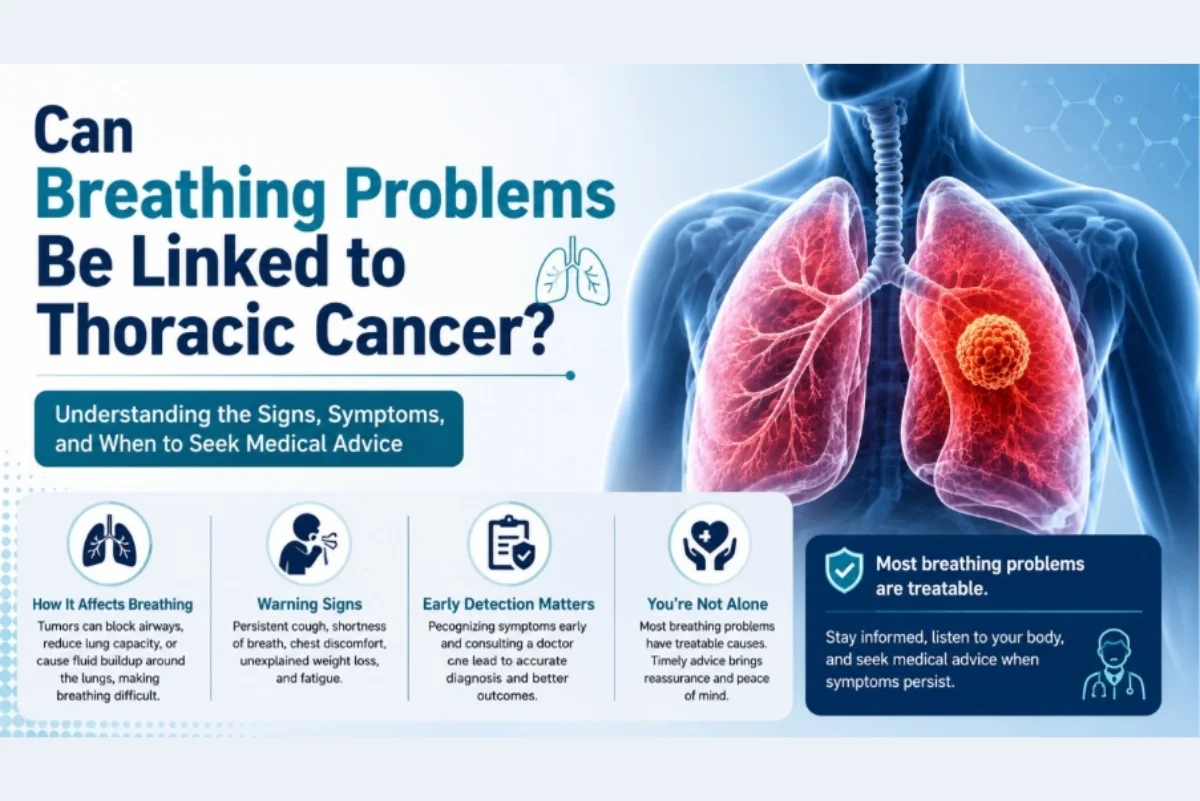
Can Breathing Problems Be Linked to Thoracic Cancer? Most of us have experienced a moment of breathlessness after climbing stairs, during a bout of cold, or on a particularly stressful day. It passes, we move on, and we do not think twice about it. But what about when shortness of breath lingers? When a cough refuses to leave? When breathing that once felt effortless suddenly takes a little more effort than it should?  These are the kinds of symptoms that quietly worry people, and understandably so. The chest is a complex space, and breathing problems can stem from many different causes. One possibility that sometimes enters the conversation is thoracic cancer, which develops in the chest region. But before that phrase triggers alarm, it is worth understanding what thoracic cancer actually means, how it connects to breathing difficulties, and why most breathing problems turn out to have far more common explanations.  What Exactly Is Thoracic Cancer? The word thoracic simply refers to the chest area. Thoracic cancer is an umbrella term for cancers that develop in the organs housed inside the chest cavity, primarily the lungs, but also the lining around the lungs (called the pleura), the windpipe (trachea), the thymus gland, and the esophagus (the food pipe running through the chest).  Lung cancer is by far the most common type. But esophageal cancer, mesothelioma (a cancer of the pleural lining), and thymic tumors also fall under this category.  Because all of these organs sit in or near the breathing pathway, it is not surprising that breathing changes are among the most frequently reported symptoms.  How Does Thoracic Cancer Affect Breathing? When a tumor develops inside or around the chest, it can interfere with breathing in several different ways:  Blocking the airway: a tumor growing inside or pressing against the trachea or bronchi (the air passages leading to the lungs) can narrow the space air travels through, causing wheezing or breathlessness  Reducing lung capacity as a lung tumor grows, it takes up space where healthy tissue used to function, making it harder for the lungs to fully expand  Fluid around the lungs: some thoracic cancers cause fluid to accumulate in the pleural space (the area between the lungs and the chest wall), a condition called pleural effusion. This fluid compresses the lungs and makes breathing feel labored and shallow  Pressing on nearby structures: tumors can press on nerves or blood vessels in the chest, affecting how the lungs and diaphragm work together  None of this is meant to cause alarm. It is simply helpful to understand the mechanism, because understanding it helps you recognize when symptoms deserve medical attention.  Breathing Problems Have Many Causes: Cancer Is Just One This is an important point worth repeating: most people with breathing difficulties do not have cancer.  Respiratory symptoms are extremely common and are far more often caused by conditions like asthma, chronic obstructive pulmonary disease (COPD), respiratory infections, acid reflux, anxiety, or even allergies. A persistent cough, for example, is one of the most common reasons people visit their doctor, and the vast majority of the time, it has a straightforward, treatable explanation.  The difference lies in the pattern and persistence of the symptoms, combined with other factors like age, smoking history, and additional warning signs.  Breathing Easier: Literally and Figuratively The most important thing to take away from this is balance. Breathing problems are common and usually have straightforward explanations. Thoracic cancer is real, but it is not the first or most likely explanation for every cough or moment of breathlessness.  What matters most is not avoiding the thought of cancer but being an informed and attentive observer of your own body. Symptoms that linger, worsen, or come with other unexplained changes deserve a medical conversation. That conversation, more often than not, will give you reassurance. And in the cases where something does need attention, having it early makes all the difference. 

Thoracic Cancer

The Silent Symptoms of Thoracic Cancer: Why Early Detection is Your Best Defence  

The Silent Symptoms of Thoracic Cancer: Why Early Detection is Your Best Defence Thoracic cancer often develops quietly. Many patients don’t notice symptoms until the cancer has already progressed. This is what makes early detection of thoracic cancer so important. When thoracic cancer is identified at the time treatment becomes more effective, recovery chances improve, and complications can be reduced.  If you’re experiencing persistent chest-related symptoms, don’t ignore them. Consulting a Thoracic Cancer Surgeon like Dr. Anuj Suketu Shah can help detect the thoracic cancer problem early and guide you toward the right treatment. It is essential to see a doctor if you have any concerns about thoracic cancer.  Thoracic cancer is a type of cancer that starts in the chest. It usually begins in the lungs. This cancer often grows slowly. Doesn’t show symptoms right away. That’s why finding it early and getting a diagnosis quickly is very important.   What Is Thoracic Cancer? Thoracic cancer includes cancers that start in the chest, such as:  Lungs  Pleura, which is the lining around the lungs  Mediastinum, the space, between the lungs  Chest wall  Lung cancer is the common type of thoracic cancer. Many people think symptoms will be clear. Thoracic cancers often start slowly and quietly.  That’s why it’s crucial to get checked out and get a proper diagnosis especially if symptoms don’t go away. Thoracic cancer needs to be taken, and lung cancer is a big part of that.  Silent Symptoms of Thoracic Cancer You Should Not Ignore Thoracic cancer symptoms are often subtle and may resemble common respiratory issues. Here are some early signs many patients overlook:  Persistent Cough That Doesn’t Go Away If you have a cough that lasts for weeks, that is one of the signs that something is wrong. A lot of people think it is because of the weather, allergies, or a cold. If you still have a cough even after taking medicine, you should see a doctor about your cough.  Especially if you notice:  You have a cough that lasts more than 2 or 3 weeks  Your cough is getting worse as time goes on  You are coughing up blood, even a little bit of blood in your cough  You should go see a doctor right away about these symptoms, about your cough. Mild Chest Pain or Discomfort Thoracic cancer may cause dull or mild chest discomfort that patients often ignore. It may feel like:  Pressure in the chest   Pain while breathing deeply   Discomfort while lying on one side   This pain is usually not severe initially, which is why many patients delay consultation.  Shortness of Breath If you feel like you cannot catch your breath when you are doing things you normally do every day, this could be a sign of Shortness of Breath. This happens when a tumor starts to affect the way your lungs work.  Patients with Shortness of Breath often say they experience things like:  Getting tired fast  Having a hard time climbing stairs  Feeling like they cannot breathe when they are walking  Unexplained Weight Loss If you are losing weight suddenly and you have not been trying to lose weight, this can be a sign that something’s wrong. Sudden weight loss without trying is a warning sign for types of cancer, including thoracic cancer.  If you’re losing weight along with:  Loss of appetite  Weakness  Fatigue  It’s important to get checked. Frequent Chest Infections Repeated chest infections like bronchitis or pneumonia may sometimes indicate an underlying issue.  If infections:  Keep coming back   Take longer to recover   Do not improve with treatment   Further evaluation may be needed. Why Early Detection Changes Everything The thing a Cancer Surgeon wants to do is find the disease when it is easy to treat. When Cancer is found early, thoracic tumors are usually small. Have not spread to other parts of the body.  More Surgical Options: when Cancer is found early, the patient can often have lung cancer surgery that is not as invasive, such as VATS, which is Video-Assisted Thoracic Surgery.  The treatment works better: numbers show that when doctors treat Cancer in its stages, people are more likely to survive.  Better Quality of Life: Early treatment usually requires less aggressive post-operative care, allowing patients to return to their families and routines sooner.  Don’t Ignore Subtle Warning Sign Many patients delay consultation because symptoms seem minor. But thoracic cancer often begins with small, silent signs. Listening to your body and acting early can make a significant difference. If you or your loved ones are experiencing persistent chest-related symptoms, consulting Dr. Anuj Suketu Shah for Thoracic Cancer Surgery in Ahmedabad can help detect the condition at a treatable stage and improve outcomes. 

Scroll to Top